The Life of Saint Malachy
Máel Máedóc Ua Morgair, known to history as St. Malachy (1094–1148), was the first native-born Irishman canonized by the Catholic Church. Born in Armagh in 1094, Malachy hailed from the noble Ua Morgair family. His early years came about in a nation recovering from Viking raids and internal strife.
Malachy’s upbringing under the tutelage of Imhar O’Hagan, a revered recluse and later abbot of Armagh, instilled in him a devotion to God and holiness. This spiritual formation shaped his character, as St. Bernard of Clairvaux (his friend and biographer) would later note, describing him as a man of noble birth yet marked by meekness and diligence. In 1119, at the age of 25, Malachy was ordained a priest by St. Cellach (Celsus), the reforming archbishop of Armagh.
Malachy’s early ministry was a calling that would define his legacy. To deepen his knowledge of liturgy and theology, he journeyed to Lismore, a hub of ecclesiastical reform in southern Ireland, where he studied for nearly two years under St. Malchus, who was a bishop renowned for his piety and learning. This period of study honed Malachy’s understanding of the Roman Church’s practices, equipping him to challenge the Celtic customs that had long dominated Irish Christianity. By 1123, he was chosen as abbot of Bangor, a historic monastery in the northeast that had been devastated by Viking incursions. Under his leadership, Bangor was restored. A year later, in 1124, Malachy was consecrated bishop of Connor, and soon after, bishop of Down.
When Connor was sacked by native princes, Malachy led the Bangor monks to Iveragh in County Kerry, where they were welcomed by King Cormac MacCarthy, prince of Desmond. There, Malachy served as confessor to Cormac, further extending his influence. His care for the needy and his reputation as a healer earned him widespread reverence, with miracles attributed to him, including the restoration of health to the afflicted. In 1129, upon Cellach’s death, Malachy was nominated as his successor to the archbishopric of Armagh. Yet this appointment broke with the Irish tradition of hereditary succession, sparking resistance from local clans.
Malachy’s ascent to Armagh was fraught with intrigue, as he faced opposition from Niall, a usurper who clung to the symbolic Bachal Isu (Staff of Jesus), which was a relic of authority. For two years, Malachy was unable to take possession of his see, and even then, he had to purchase the staff to secure his position. From 1132 to 1137, he ruled as archbishop, working to restore ecclesiastical discipline. St. Bernard recounts how Malachy “extirpated barbarism and re-established Christian morals,” introducing Roman liturgy, reinstating marriage, and renewing the sacraments of confession and confirmation. His reforms brought Ireland’s Church into closer alignment with Rome. In 1137, after five years of leadership, Malachy resigned the archbishopric, retaining only the bishopric of Down, where he continued his episcopal labors, founding a priory of Augustinian Canons at Downpatrick.
In 1139, Malachy embarked on a pilgrimage to Rome via Scotland, England, and France, seeking the pallium (a symbol of metropolitan jurisdiction) for Armagh and Cashel. On the way, he visited St. Bernard at Clairvaux, forging a lifelong friendship. Pope Innocent II appointed him papal legate for Ireland but denied the pallium, urging a national synod to formally request it. On his return, Malachy brought five Cistercian monks from Clairvaux, led by an Irishman named Christian, to establish Mellifont Abbey in Louth in 1142, introducing the Cistercian order to Ireland. He also visited Arrouaise in Flanders, inspiring the founding of St. Mary’s Abbey in Louth under Augustinian Canons.
Malachy’s final years involved continued reform efforts as papal legate, holding synods, and enacting new church laws. In 1148, he set out for Rome again to renew his pallium request, prompted by a synod near Skerries. Delayed by King Stephen of England’s dispute with the papacy, he reached Clairvaux, where he fell gravely ill. On November 2, 1148, Malachy died in St. Bernard’s arms. Canonized by Pope Clement III in 1190, his feast is celebrated on November 3 to avoid All Souls’ Day. His relics, initially interred at Clairvaux, were later distributed, with portions sent to Mellifont and other Irish abbeys in 1194. Malachy’s skull, preserved in Troyes Cathedral, and other relics remain venerated.
Notes
William Grattan-Flood. “St. Malachy.” The Catholic Encyclopedia, Vol. 9. (New York: Robert Appleton Company, 1910). https://www.newadvent.org/cathen/09565a.htm.
“Saint Malachy.” Encyclopædia Britannica. 2024. https://www.britannica.com/biography/Saint-Malachy.
Saint Malachy Parish. “Patron Saint.” https://www.saintmalachy.org/Home/PatronSaint.aspx.
William Grattan-Flood. “St. Malachy.” The Catholic Encyclopedia, Vol. 9 (New York: Robert Appleton Company, 1910). https://www.newadvent.org/cathen/09565a.htm.
Ibid.
“Saint Malachy.” Encyclopædia Britannica. 2024. https://www.britannica.com/biography/Saint-Malachy.
Saint Malachy Parish. “Patron Saint.” https://www.saintmalachy.org/Home/PatronSaint.aspx.
Get the Daily Renegade Newsletter
New articles, research, releases, videos, and major updates from Renegade Publishers.
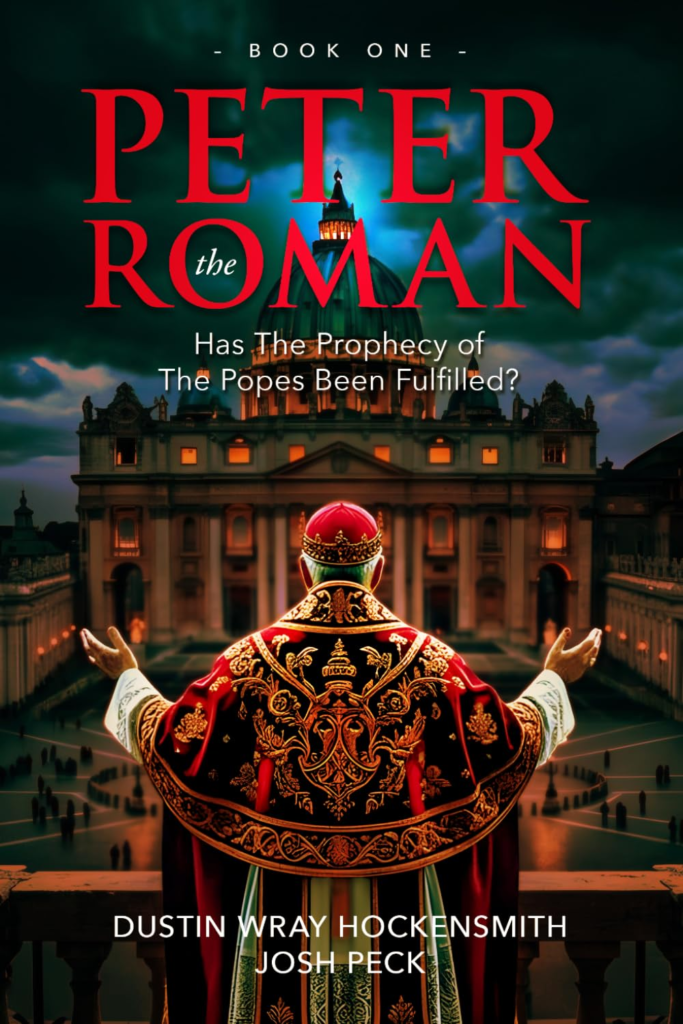
Excerpted from Peter the Roman: Has the Prophecy of the Popes Been Fulfilled? Book 1 by Dustin Wray Hockensmith & Josh Peck.